
I bought a couch last year that looked incredible online. Sleek, modern, the kind of thing you’d see in a magazine spread. It showed up and absolutely swallowed my living room. Couldn’t even open the balcony door properly. Returned it three weeks later after living in what felt like a furniture warehouse.
That experience got me looking into something I’d been hearing about but never tried: tools that go from photo to 3d model and let you actually see furniture in your room before you commit. And honestly, I wish I’d known about this before dropping $1,400 on a sofa that turned my apartment into an obstacle course.
We’ve All Been There
You find a dining table on some website. The dimensions say 72 inches. You pull out a tape measure, mark the floor, and think “yeah, that works.” But dimensions on a flat floor tell you nothing about how the table will feel in the room. Will it crowd the kitchen island? Will you have to squeeze past it every time you walk to the fridge? You genuinely cannot know until the thing shows up on a delivery truck.
And if you’re working with a smaller space, one bad purchase can basically ruin the entire layout. Suddenly your carefully planned living room feels like a storage unit.
First-time homeowners get hit the hardest by this. You’ve just spent everything on the down payment, you’re furnishing an entire house from scratch, and every wrong purchase is money you don’t have to waste. I’ve talked to people who’ve spent north of $3,000 on furniture returns in their first year. That’s real money gone on shipping and restocking fees alone.
So What Actually Changed?
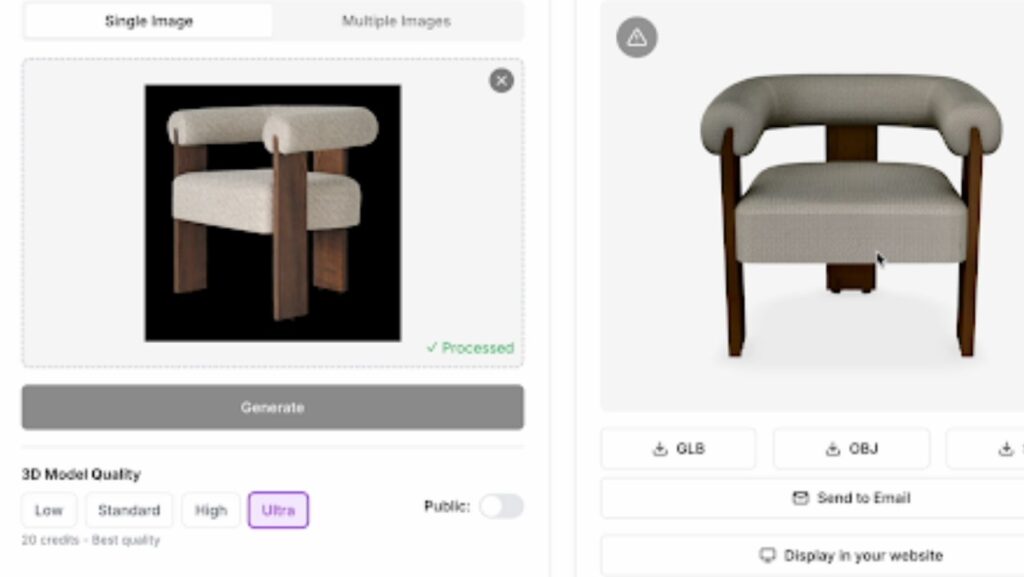
The short version: you can now take a photo of literally any piece of furniture and turn it into a 3D object. Not a flat cutout pasted onto a room photo. An actual three-dimensional model you can spin around, resize, and drop into a virtual version of your space.
It works better than I expected. You snap a picture of a chair from a catalog or a website screenshot, upload it, and get back something you can rotate and examine from every angle. Then you place it next to your other stuff and immediately see if it works or if it’s going to be another expensive mistake.

The tech behind it is machine learning, but you don’t need to understand any of that. You just upload and get your model back.
Why I Think This Actually Matters
Look, there’s no shortage of home design apps out there. Most of them are glorified mood boards. Pretty to look at, useless in practice.
What makes 3D furniture modeling different is that it deals with the thing that actually causes problems: spatial relationships. How big is this table relative to these chairs? Does this bookshelf block the window? If I put the TV console here, can I still open the closet door?
These are boring, practical questions. But they’re the questions that determine whether your room feels like home or feels like you’re constantly bumping into things.
If you’re doing a bigger project, like a full apartment renovation, being able to test furniture layouts digitally before the drywall is even up saves you from committing to a floor plan that looks great on paper but doesn’t work with the furniture you actually own.
Some Things I’ve Learned Using These Tools
Start big. Seriously, don’t waste time modeling throw pillows. Do the couch, the bed, the dining table first. Those are the pieces that define your room. Everything else is just filling gaps.
Good photos matter more than you’d think. I tried uploading a dark, blurry picture of a vintage credenza I found on Facebook Marketplace and the model came out looking like a melted rectangle. Took a better photo in daylight and it was actually usable.
Don’t settle on your first layout. The whole point of doing this digitally is that moving a virtual couch costs you zero effort. In real life, rearranging a sectional is a two-person, sweaty, 45-minute ordeal. Digitally, it’s a click. So try weird stuff. Put the couch at an angle. Float it in the middle of the room. You might be surprised.
And get your family involved. My partner has vetoed approximately 100% of my solo furniture decisions. But when I showed her a 3D layout with everything placed, she actually got excited about it instead of skeptical. Turns out people are way more receptive when they can see it rather than just hear you describe it.
It’s Not Just for Design Nerds
There’s this assumption that 3D modeling is complicated. And yeah, if you’re talking about Blender or SketchUp, there’s a real learning curve. But the newer furniture-specific tools are built for regular people. No tutorials needed.
What’s cool is that this kind of spatial planning used to cost thousands if you hired an interior designer to do it for you. Now it’s accessible to anyone with a phone camera. Combine it with some budget-friendly renovation ideas and you can genuinely transform a room without blowing your savings.
Bottom Line
If you’re moving into a new place or just tired of your current setup, do yourself a favor and try visualizing your furniture in 3D before you buy anything. I can’t overstate how much frustration it saves. No more measuring tape guesswork, no more “I think it’ll fit,” no more expensive returns.
Your living room deserves better than trial and error.
More Stories
How to Reclaim a Garage That Has Become a Storage Space
Are Millipedes Dangerous or Mostly a Moisture Problem?
What Anaheim Families Should Know About Termite Activity Near Living Spaces