

Put two aluminum poster frames side by side and they can look identical: same profile width, same silver finish, same catalog photo. The difference sits where buyers rarely check: a traceable alloy, tight tolerances, a measured coating and a tested batch.
Professional frame manufacturing means controlling every stage, from the alloy and its heat treatment to cutting accuracy, corner joining, surface finish, mechanism durability and batch inspection, and documenting that control. For commercial signage, where hundreds of frames must match and last for years, that documentation turns a product into a dependable specification.
Mass-Produced, Custom or Precision-Built: Where the Real Cost Difference Comes From
The key difference is not volume but process control. Each model has a legitimate place and a real limitation.
-
High-volume stock production gives the lowest unit price and fast delivery, but quality control is often visual only, and alloy, temper or coating thickness may not be stated, so next year’s reorder may not match.
-
Small custom workshops build any size within days, but manual cutting makes identical frames across a multi-site rollout hard, and few test mechanisms or finishes formally.
-
Professional production lines combine controlled profile sourcing, automated cutting, controlled finishing and documented inspection for both catalog and custom batches. The trade-off is a higher unit price and longer lead times.
Over time, a cheap frame repaired after two seasons often costs more than a precise one.
6063, 6061 or 6060? Why the Alloy on the Mill Certificate Matters More Than the Catalog Photo
Most quality signage profiles are extruded from 6063 or its European counterpart 6060, which combine good strength with a smooth surface that anodizes well. A professional manufacturer states the alloy and can prove it.
In Europe, proof is usually an EN 10204 type 3.1 inspection certificate confirming the batch’s composition and mechanical properties. In North America, profiles are specified under ASTM B221, with tolerances per ANSI H35.2, or EN 755 and EN 12020 in Europe. Buyers with sustainability targets also ask about recycled content, which needs around 5 percent of the energy of primary metal, and Aluminium Stewardship Initiative certification.
Why Temper, Not Wall Thickness, Decides Whether a Profile Bends Under Load
Temper, defined in ANSI H35.1, determines how strong a profile actually is. Typical values for 6063 are around 145 MPa yield strength in T5 against roughly 215 MPa in T6, so a thin, correctly tempered profile can outperform a thicker, poorly aged one. Ask which temper a supplier uses and how they verify it; many plants check it on the line with a Webster hardness tester.
Tenths of a Millimeter: How Cutting and Corner Joining Separate a Tight Frame From a Rattling One
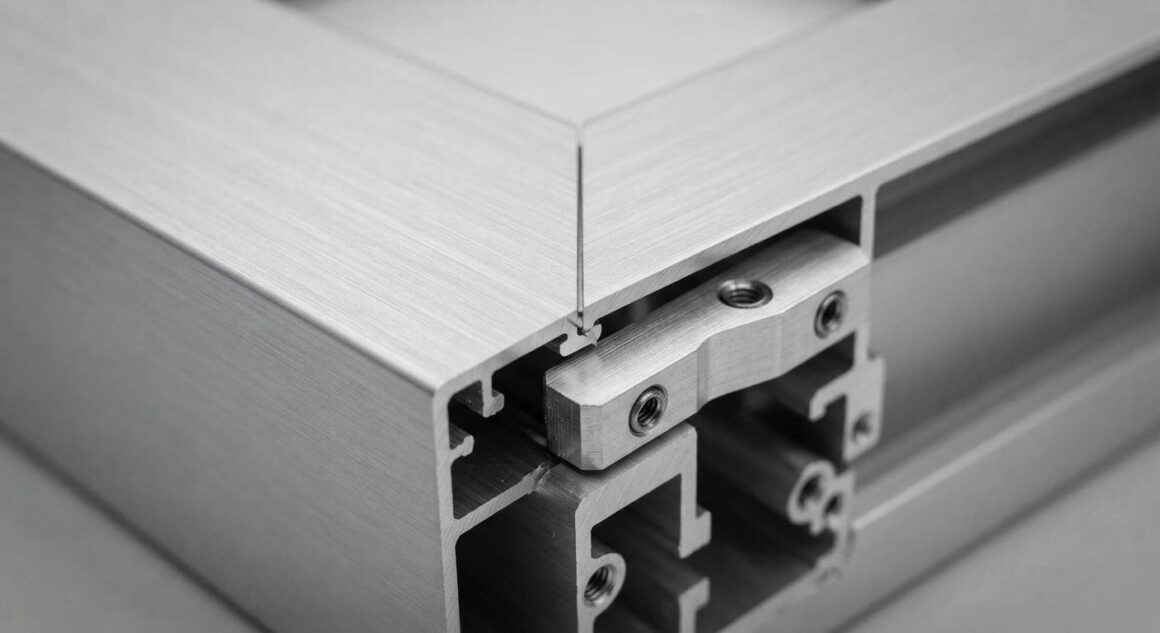
Corners reveal the quality of the whole process. Professional lines use automated double-miter saws that cut both ends at once; on a large frame, even a fraction of a degree per corner can leave a gap or make a door bind. Joining methods each have their place:
-
Crimped corner keys give strong, flush corners for volume production but are hard to repair on site.
-
Screwed corner keys allow disassembly and repair, though they can loosen without locking features.
-
Welded corners are the stiffest option for large or security frames, at higher cost and with refinishing required.
The Finish Nobody Measures Until It Starts Peeling
A finish should be specified by measured properties, not color. For anodizing, AAMA 611 defines Class II at 0.4 to 0.7 mil (about 10 to 18 microns) and Class I at 0.7 mil or more; thickness is checked under ISO 2360 and sealing under ISO 3210 or ASTM B680, with Qualanod certifying plants in Europe.
For powder coating, AAMA 2603, 2604 and 2605 set increasing requirements, and Qualicoat plays a similar role. Powders typically cure at 180 to 200 °C for 10 to 20 minutes, and both under- and over-curing weaken them. Adhesion is tested under ASTM D3359 or ISO 2409, corrosion under ASTM B117 or ISO 9227.
How Many Openings Can a Hinge Survive Before the Door Sags?
Mechanism life should be stated as tested open-close cycles. There is no dedicated frame standard, but building hardware offers benchmarks: EN 1935 grades hinges from 10,000 to 200,000 cycles, and ANSI/BHMA A156.1 uses 350,000, 1,500,000 and 2,500,000. Ask how many cycles the mechanism was tested to, under what load, and what counted as failure.
The Quality-Control Step Most Frame Suppliers Skip Before Shipping
The step most often skipped is statistical batch inspection. Professional manufacturers sample each batch under ISO 2859-1 or ANSI/ASQ Z1.4, measure dimensions, finish and function, and release it only within defined limits. With an ISO 9001 system, this creates a documented trail. For custom orders, a first-article inspection stops a drawing error from repeating across hundreds of units. Records are what guarantee that frame number 500 matches frame number 1.
Can a Factory Build Custom Sizes Without Losing Consistency?
Yes, if custom work runs through the same controlled process. Custom frame manufacturing is reliable when non-standard sizes, colors or mechanisms use the same certified profiles, equipment and inspection steps rather than being one-off exceptions.
Manufacturers such as SwingFrame, among others, standardize profiles, finishes and hinges while configuring dimensions, colors, glazing and mounting per project, inspecting custom batches like catalog orders. The limitation is time: fully inspected custom batches take longer than stock products.
Signs of a Professional Manufacturer vs a Volume Reseller
Professional frame manufacturing leaves evidence: certificates, test data, stated tolerances and a warranty backed by records. The comparison below summarizes what to check.
|
What to check |
Professional manufacturer |
Typical mass or non-professional supplier |
|
Material certification |
States alloy and temper; supplies EN 10204 3.1 certificates or equivalent |
Describes material only as “aluminum”; no batch documentation |
|
Dimensional tolerances |
Works to EN 12020, EN 755 or ANSI H35.2 and states tolerances |
No stated tolerances; variation between batches |
|
Finish specification |
Names AAMA class, Qualanod or Qualicoat status; measures coating thickness |
Specifies color only |
|
Mechanism testing |
States tested cycle counts and test conditions |
Uses terms such as “durable” or “heavy-duty” |
|
Batch inspection |
Samples batches to ISO 2859-1 or ANSI/ASQ Z1.4; keeps records |
Visual checks, if any |
|
Quality system |
ISO 9001 certified, with traceable records |
No certified system |
|
Customization |
Custom sizes built on certified components, inspected the same way |
No customization, or one-off builds without inspection |
|
Warranty |
Written warranty with defined coverage, supported by spare parts |
Short or vague, often excluding finish and mechanisms |
Before You Sign the Purchase Order: Five Things to Verify With Any Frame Manufacturer
1. Certificates and documentation
Ask for the ISO 9001 certificate, a sample material certificate and the finish specification with its AAMA, Qualanod or Qualicoat reference.
2. Samples you test yourself
Request a production sample, not a showroom piece. Check corners for gaps, cycle the mechanism dozens of times, measure diagonals for squareness and compare the finish with the specification.
3. Batch testing and inspection records
Ask which sampling standard is used, what is measured, and whether inspection records ship with delivery. For custom orders, request first-article approval.
4. Warranty terms
Check coverage for profile, finish, mechanism and glazing, plus duration, exclusions and availability of spare gaskets, hinges and front sheets.
5. A look inside the factory
For large contracts, ask for a visit or video audit. Look for automated cutting, controlled finishing, a dedicated inspection area and traceable batch labeling.
Warning signs include prices far below market, reluctance to name the alloy or finish class, no written warranty, and samples that differ from delivered goods. Together, they suggest quality depends on luck, not process.
More Stories
Auckland Moves With Pets: Making the Change Easier
What Buyers Should Ask About a Property’s Water Source
I Want a Built-In Look Around My TV, But I Don’t Want to Renovate