
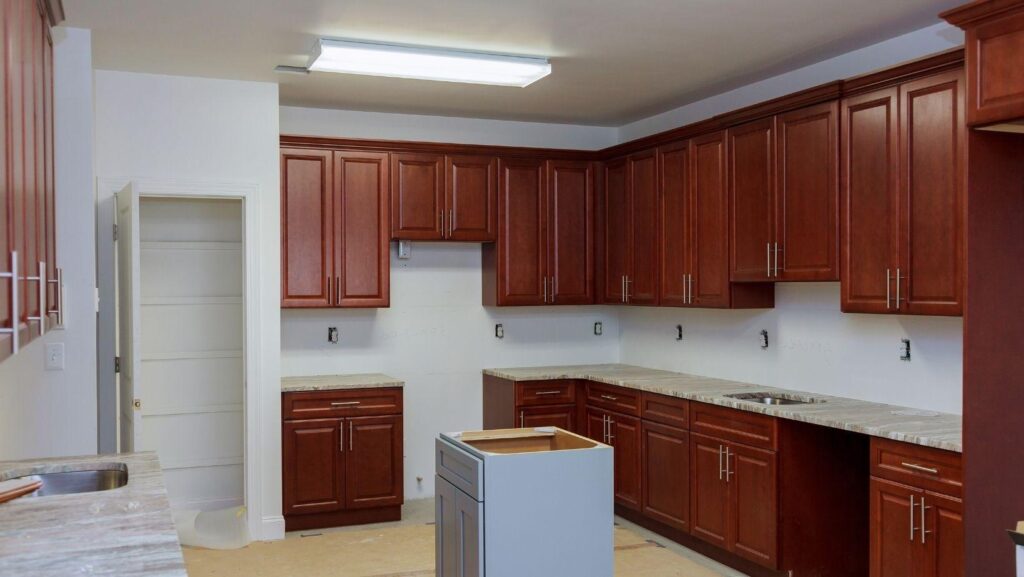
Homeowners planning a kitchen renovation spend weeks choosing a stain color. They collect chips, they photograph samples in different light, and they settle on the exact shade they want. Then the cabinets arrive finished in that color and something looks wrong. The tone is heavier than expected, or the grain is louder, or the surface has a mottled quality nobody warned them about.
The stain was not the problem. The wood was.
Stain is not paint. Paint sits on the surface and covers what is underneath. Stain penetrates the wood and colors it from within, which means the wood itself is half of the equation. The same can of stain applied to oak, maple, and birch will produce three noticeably different results, and understanding why is one of the most useful things a homeowner can learn before committing to a cabinet order.
Why Species Matters More Than Most Buyers Expect
Wood absorbs stain through its pores. Species differ enormously in pore size, pore distribution, and density, which means they differ enormously in how much pigment they take up and where that pigment lands.
Open-grained species have large, visible pores that soak up stain readily. The result is high contrast: the pores go dark, the surrounding wood stays lighter, and the grain pattern becomes the dominant visual feature of the door.
Closed-grained species have small, tightly packed pores. They resist stain absorption, which sounds like it would produce a lighter result. Often it does, but it also produces something less predictable, because the small amount of stain that does penetrate tends to go in unevenly.
Density adds a second variable. Denser woods absorb less. Softer areas within a single board absorb more. That variation within one piece of wood is where most finishing frustration originates.
Red Oak: The Open Grain Problem
Red oak is the species most people picture when they imagine stained cabinetry, and for decades it dominated American kitchens for exactly that reason.
Its pores are large and arranged in distinct rings. When stain hits red oak, those pores fill with pigment and go considerably darker than the wood around them. The grain does not just show through the finish. The grain becomes the finish.
What This Means Practically
Red oak is the most forgiving species to stain. The heavy grain pattern hides application inconsistencies, lap marks, and minor blotching, because the eye reads the visible grain and stops looking for anything else. For a homeowner finishing cabinets without professional equipment, this forgiveness is genuinely valuable.
The tradeoff is that you cannot make red oak look like anything other than red oak. A dark walnut stain on oak produces dark oak, not walnut. The pore structure remains legible under any color, and it will read as traditional rather than contemporary no matter what shade sits on top.
There is also an undertone issue worth knowing. Red oak has a pinkish cast that pushes warm colors warmer and fights cool grays. Homeowners who want a gray-stained kitchen and choose red oak often end up with something that reads slightly purple.
Maple: Beautiful, Difficult, and Prone to Blotching
Maple is a closed-grain hardwood with a smooth, nearly uniform surface and a subtle, refined grain pattern. It is the species most people want when they want stained cabinetry that looks contemporary rather than traditional.
It is also the species that causes the most finishing problems.
The Blotching Issue
Maple’s density varies within a single board. Some areas absorb stain heavily, others barely at all, and because there is no strong grain pattern to distract the eye, that variation shows up as visible patches of uneven color. Finishers call this blotching, and it is the single most common complaint about stained maple.
The problem is not a defect and it is not a sign of low-quality wood. It is a characteristic of the species. Professional finishers manage it by applying a conditioner or washcoat before staining, which partially seals the wood so that absorption becomes more even.
A homeowner who skips that step and applies stain directly to raw maple will almost always get a result that looks patchy. A homeowner who knows about the step gets a beautiful finish. The difference is entirely in the preparation.
Where Maple Excels
For light stains, natural finishes, and paint, maple is excellent. Its smooth surface takes paint better than almost any other cabinet species, with no grain telegraphing through the color. For medium and dark stains, it requires the extra preparation step and rewards it with a clean, understated look that oak simply cannot produce.
Birch: The Paint-Grade Default
Birch occupies an interesting position in the cabinet market. It is closed-grained like maple, less expensive than maple, and has a fine, relatively uniform texture.
It is also the species most commonly used for cabinet boxes and paint-grade doors, and there is good reason for that. Birch takes paint cleanly, holds an edge well when machined, and costs meaningfully less than the premium hardwoods.
The Stain Caveat
Birch shares maple’s blotching tendency and adds one of its own. Birch plywood and birch solid stock frequently do not match in color, so a stained birch cabinet can show a visible difference between the door and the box face. Under paint this is invisible. Under stain it is obvious.
The practical guidance most finishers give is straightforward: birch is a paint-grade species. If the plan is a painted kitchen, birch delivers excellent results at a lower cost. If the plan is a stained kitchen, choose oak or accept the preparation work that maple requires.
Poplar, Alder, and the Middle Ground
Two other species show up regularly in cabinet lines and deserve brief mention.
Poplar is soft, inexpensive, and almost exclusively a paint-grade wood. It has green and purple mineral streaking that no stain will hide, and it dents more easily than the hardwoods. For painted cabinetry on a budget, it works. For anything stained, it does not.
Alder sits between oak and maple in behavior. It is softer than both, takes stain more evenly than maple without the heavy pore structure of oak, and has a warm natural tone that suits medium browns particularly well. It is a common choice for rustic and craftsman styles, and it is considerably more forgiving than maple for a homeowner finishing at home.
Why Sample Doors Mislead Buyers
Here is the practical trap that catches most homeowners.
A showroom sample door is a small piece of carefully selected wood, finished by a professional under controlled conditions. It is chosen because it looks good. It is not representative of the natural variation across an entire kitchen’s worth of doors.
Two things follow from this. First, the color you see on a four-inch sample will read differently across a full run of upper and lower cabinets, because scale changes how the eye perceives tone. Darker colors read darker at scale. Second, the sample tells you nothing about how that same stain behaves on a different species, which is the exact substitution buyers often make when they discover the sample species is over budget.
This is a large part of why so many homeowners now buy unfinished kitchen cabinets and finish them at home. Buying the boxes and doors raw means you can test your chosen stain on an actual door from your actual order, on the actual species you are receiving, in the actual light of your actual kitchen, before committing to the entire run. That test costs an afternoon. Discovering the problem after a finished kitchen arrives costs considerably more than that.
It also means the species decision and the color decision get separated. Instead of choosing from whatever finish combinations a manufacturer happens to offer, you pick the species that suits your grain preference and budget, then pick any color you want on top of it.
Making the Decision Before You Order
The sequence that avoids most problems runs in this order.
- Decide paint or stain first. This single choice eliminates most of the species field immediately. Paint points toward birch, poplar, or maple. Stain points toward oak, alder, or maple with conditioner.
- Match the species to the grain look you want, not the color. Color is adjustable. Pore structure is not. If you want visible, dramatic grain, oak. If you want a quiet, smooth surface, maple.
- Test on the real material. Buy or request one door in the species you are ordering and try your stain on it before committing.
- Account for undertone. Red oak pushes warm. Maple runs neutral to slightly yellow. Alder leans warm brown. These undertones will shift your chosen color, and no amount of stain will fully override them.
Conclusion
Species selection is treated as a budget decision in most cabinet conversations, ranked from cheapest to most expensive with little discussion of what actually distinguishes them. That framing costs homeowners the finish they wanted.
Oak takes stain readily and displays it through a dominant grain pattern that no color will subdue. Maple takes stain reluctantly and unevenly without preparation, and beautifully with it. Birch belongs under paint. Alder sits comfortably in between. These are not quality rankings. They are behavioral differences that determine whether the color on the chip ends up being the color on the wall.
The homeowners who get the result they pictured are the ones who understood that the stain and the wood are a single system, and who tested that system on real material before the whole kitchen was committed. It is a small amount of homework at the front of a project that prevents the most expensive kind of disappointment at the end of one.
More Stories
Are Millipedes Dangerous or Mostly a Moisture Problem?
What Anaheim Families Should Know About Termite Activity Near Living Spaces
How West Sacramento Homes Can Reduce Pest Pressure Near Entryways and Garages