
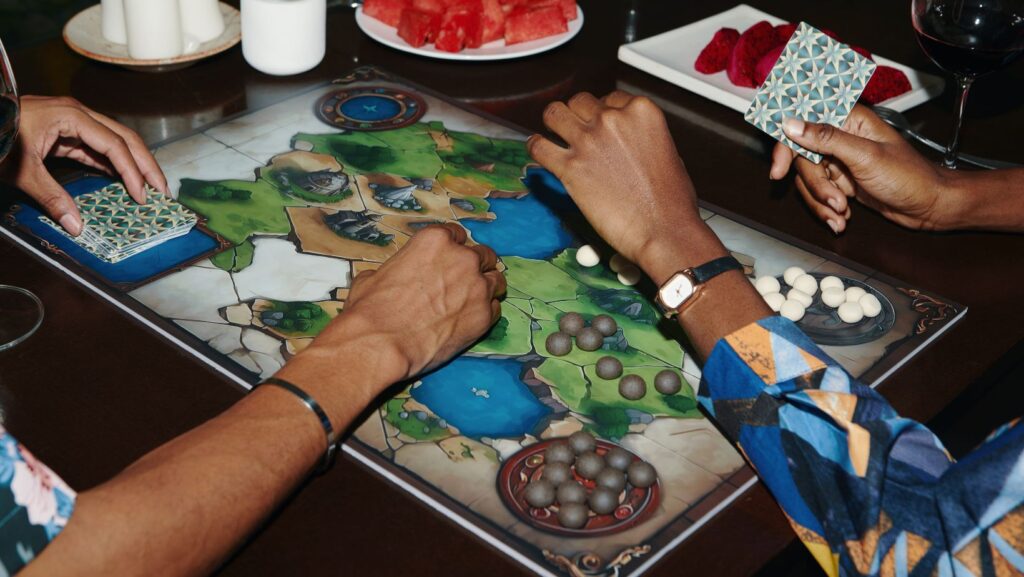
There’s something uniquely satisfying about gathering around a table, shuffling a deck, rolling a die, and watching a quiet evening turn into noisy, joyful chaos. Even people who usually get their competitive fix from online wagers or browsing sites where you might click here to test their luck can find that face-to-face games create a very different kind of thrill: one built on shared jokes, silly mistakes, and social tension that ends in laughter rather than stress.
To understand why some games have everyone howling with amusement while others stay politely quiet, it helps to look at the types of games rather than specific titles. Below are ten categories of board games that reliably turn a calm night into a cheerful, animated one—and what’s happening under the hood that makes them so effective.
1. Quick-Fire Word Association Games
These are the games where players race against a timer to find words, connect concepts, or give clues under pressure. The humor comes from frantic thinking: your brain knows exactly what you don’t want to say, and that’s usually what pops out. Mispronounced words, wildly off-target guesses, and accidental double meanings generate a stream of spontaneous jokes. Analytically, these games work because they force rapid, imperfect communication, which is fertile ground for comedy.
2. Improv Storytelling Games
In storytelling games, players build a narrative together—sentence by sentence, card by card, or scene by scene. The rules might impose absurd constraints: describe a character in three ridiculous adjectives, or justify a bizarre plot twist. The shared story often collapses into delightful nonsense. These games are powerful laugh engines because they tap into collaborative creativity; players feel safe being ridiculous when everyone else is doing it too.
3. Hidden Role and Social Deception Games
Few things are funnier than watching your most honest friend attempt to bluff their way out of obvious suspicion. Hidden-role games ask you to lie, probe, accuse, and defend, all while maintaining a straight face. The laughter isn’t just about deception; it’s about failed deception—cracks in the mask, nervous giggles, over-the-top theatrics. Social dynamics become the core mechanic, turning the game into a playful study of trust, intuition, and human tells.
4. Cooperative “We’re All Going to Lose” Games
Some cooperative games are designed so tightly that failure feels almost inevitable. Oddly, that’s where the laughs come from. When everyone knows the odds are stacked against them, there’s freedom to make bold, even reckless moves. Mishaps become funny instead of frustrating, because no one person is to blame. The group experiences tension followed by collective relief: “We were doomed anyway—at least we went down in style.”
5. Mismatched Role or Character Games
These are games where your role and your personality don’t naturally align: a timid player might be forced to act as an intimidating villain, or a quiet introvert suddenly becomes the loud spokesperson for a group. The rules encourage exaggerated behavior—using accents, acting out traits, or adopting strange quirks. The analytical magic here is identity dissonance: the gap between who you are and who the game makes you pretend to be is inherently funny, especially to people who know you well.
6. Drawing Games for People Who “Can’t Draw”
Drawing games are least fun with skilled artists and most fun with doodlers and stick-figure specialists. When everyone is equally terrible, the barrier to participation disappears, and the joy comes from misinterpretation: a “cat” that looks like a potato, or a “space station” that could pass for kitchen appliances. These games use visual ambiguity to create humor; the brain tries to impose meaning on messy sketches, and the results are often absurd.
7. Real-Life Scenario Parody Games
Some games cleverly mimic real-life situations—work meetings, awkward parties, reality shows, or petty neighborhood disputes—but push them into exaggerated territory. You might have to negotiate over trivial resources, pitch ridiculous ideas, or argue passionately about nonsense. The laughter here is partly cathartic: you recognize echoes of real life, but in a space where you can mock them safely. It’s social satire wrapped in cardboard and dice.
8. Push-Your-Luck Chaos Games
In push-your-luck games, each decision balances safety against greed. Do you stop now and secure a small gain, or go a little further and risk losing everything? The group collectively leans in every time someone decides to take “just one more” step. The comedy is rhythmic: tension, suspense, sudden disaster, then shared laughter. These games highlight our irrational optimism and love of risk, but in a low-stakes, friendly environment rather than anything truly consequential.
9. Asymmetrical Power Games
Here, players have wildly different abilities, resources, or goals. One player may seem overpowered, while others form shifting alliances to pull them down. The imbalance generates lively table talk, melodramatic speeches, and flamboyant betrayals. Humor arises from the theatrical contrast between the “mighty” and the “underdogs,” especially when power unexpectedly flips and the once-dominant player finds themselves hilariously outmaneuvered.
10. Rule-Twisting Meta Games
Finally, there are games where the rules themselves are part of the joke. Maybe players secretly add or change rules. Maybe the rulebook encourages strange table behavior, like speaking in whispers or avoiding specific words. These games often generate laughter not from what happens “in the story,” but from how the game keeps surprising the players with odd constraints. It’s a playful reminder that we’ve all agreed to enter a small, temporary world where normal logic doesn’t apply.
Choosing the Right Game for Your Group

Not every group enjoys the same flavor of fun, and that’s where a bit of analysis pays off:
- Shy or mixed-comfort groups usually do better with cooperative or drawing games where performance pressure is low.
- Outgoing, theatrical groups often thrive on social deception, role-play, and storytelling.
- Strategy lovers might enjoy asymmetrical or push-your-luck games that still leave room for banter.
- Mixed-age gatherings tend to work best with simple rules, visual components, and fast turns to keep everyone engaged.
Pay attention to how your friends react. If arguments linger after the game, lean more cooperative next time. If people are chatting enthusiastically about their characters or ridiculous mistakes, you’ve probably hit the sweet spot.
The Real Secret Ingredient: The People
In the end, the funniest board game nights are less about the perfect ruleset and more about the people at the table. A simple game can become legendary with the right mix of personalities, inside jokes, and shared history. What these ten categories have in common is that they all invite you to be imperfect, impulsive, and a bit ridiculous together.
That’s why a quiet night with a humble stack of cardboard can turn into a loud, unforgettable memory: the game is just the excuse. The real “engine” of laughter is the group of friends around the table, telling stories they’ll be laughing about for years.
More Stories
Low-Budget Tradeshow Giveaway Ideas That Still Impress Visitors
How Digital Trends Influence Today’s Modern Interior Design
Five Winter-Friendly Hobbies to Try