

Most growing companies plan their corporate office space around the number of people on the payroll. That instinct is expensive. CBRE’s 2026 Global Workplace & Occupancy Insights found that the global occupancy rate now sits at 111%: companies assign more people to a location than they have physical desks. Hybrid schedules make that work, but only when the space is planned around attendance patterns, not org charts. For a growing team weighing whether to rent a space for business on a flex agreement or commit to a long-term lease, this is the math to get right first.
Attendance Data Comes Before Floor Plans
Planning corporate space starts with measuring how people actually show up. JLL’s 2025 Occupancy Planning Benchmark found that global office utilization reached 54%, up from 49% the year before and 41% in 2023.
CBRE’s data adds a second layer: 70% of organizations report that employees come in less often than leadership expects. The gap between assumed and actual attendance is where most oversizing starts. JLL’s data also shows that attendance clusters mid-week, with Monday and Friday running well below Tuesday through Thursday, which means a single average attendance number hides the real peaks and valleys.
What to Measure Before Making a Space Decision
- Average daily attendance, tracked per day of the week (Tuesday through Thursday typically peaks).
- Peak-day headcount vs. total employee count.
- Which zones people actually use (badge swipes, WiFi connections, booking system data).
- Meeting room booking rates vs. actual room occupancy.
JLL found that only 7% of organizations rate their space data collection as excellent, and 20% report poor or no capability at all. Collecting at least one full quarter of real attendance data before committing to a new space or an expansion cuts the most common sizing errors.
What One Desk Per Person Costs

CBRE’s 2026 survey shows that 69% of participating companies report more than 40% of their workers no longer have a designated desk. No organization in the survey targets a one-to-one seating ratio. The most common target is a moderate ratio of 1.01 to 1.49 people per seat.
What Drives the Ratio
CBRE found that organizations set their sharing ratios based on:
- Job functions (83% of organizations).
- Space-utilization data (78%).
- Supply/demand metrics (68%).
What It Costs in Dollars
JLL’s 2025 data shows the average planned reduction from 165 square feet per person to 132 square feet per person.
| Team Size | Old Standard (165 sq ft) | New Target (132 sq ft) | Annual Savings at $40/sq ft |
| 50 | 8,250 sq ft | 6,600 sq ft | ~$66,000 |
| 100 | 16,500 sq ft | 13,200 sq ft | ~$132,000 |
| 200 | 33,000 sq ft | 26,400 sq ft | ~$264,000 |
Those savings only hold if people can still find a place to sit. Cutting too aggressively creates “desk anxiety,” where employees stop coming in because they’re not sure a seat will be open. Communicating the ratio and showing live seat availability through a booking system reduces that friction. Base the ratio on your own peak-day data, add a 10-15% buffer, and tighten only after a quarter of booking data confirms the numbers.
Fixing the Meeting Room Imbalance
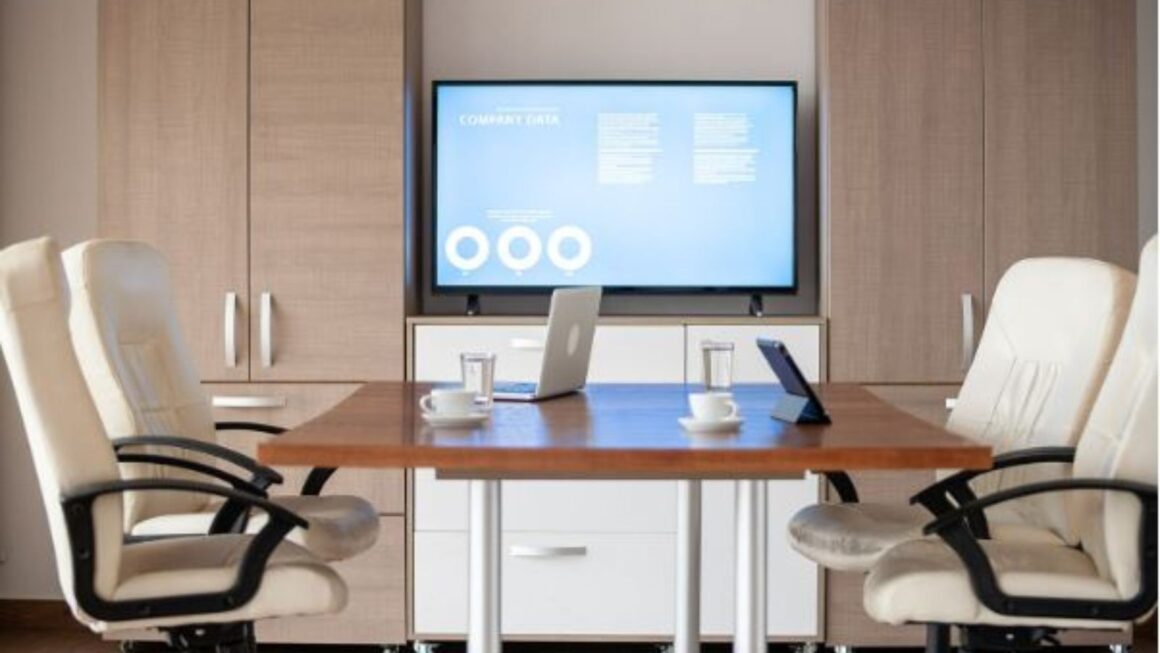
Worklytics’ analysis of hybrid meeting room data from 2023 to 2025 found that the booking-to-occupancy ratio dropped from 0.85 to 0.71. People reserve space, then cancel, switch to a video call, or skip the meeting without releasing the room. Worklytics estimates this pattern costs a typical office 15 to 20 seat-hours of lost capacity per conference room per day.
The result: a calendar that reads “full” and a floor that looks empty.
Two Fixes That Make the Most Difference
When planning corporate meeting space, the booking system and the room mix are the two changes with the biggest payoff.
- Auto-release policies. If nobody checks in within 10 minutes, the room goes back into the pool. This alone recovers a large share of the lost seat-hours.
- Rebalance toward smaller rooms. CBRE reports that collaboration spaces see the largest utilization gains year over year, and that 68% of employees cite collaboration as their primary reason for coming to the office. The demand is for quick huddles and small team syncs. For most hybrid offices, 60-70% of bookable rooms should seat six or fewer.
Lease Structures That Grow With You
A lease signed for today’s headcount becomes a liability the moment hiring plans change. This applies whether you are expanding an existing corporate office space or signing your first dedicated lease after outgrowing a coworking membership. Three provisions protect a growing team:
- Right of first offer (ROFO). Priority on adjacent space as it opens. You grow within the building without relocating.
- Early termination clause. A defined exit if the space no longer fits, with pre-agreed financial terms.
- Sublease rights. Permission to sublet unused portions when a team goes remote or a hiring plan changes.
Shorter initial terms (three to five years) paired with expansion options give growing companies control without overcommitting. Planning corporate space at least 18 months ahead of current headcount prevents the most disruptive type of office move: the one forced by a lease that ran out of room. For a team of 40 expecting to hit 60 within two years, that means signing for space that fits 60 today and negotiating a ROFO for the floor above.
Match Your Review Cycle to Your Growth Rate
CBRE reports that 87% of organizations now set explicit utilization targets for their corporate office space, with nearly half aiming for 76-85% building utilization.
A Review Should Answer Four Questions
- Is peak-day attendance trending up, down, or flat?
- Are meeting rooms being booked but not occupied?
- What is the cost per employee per month, and how has it moved?
- Are any zones consistently overcrowded or consistently empty?
How often you review depends on how fast the team is changing. A company adding five people a quarter can review twice a year. A company that doubled in 12 months needs these numbers every quarter.
The Overpaying Starts Before You Move In
The most expensive square footage is the space you pay for and nobody uses. For growing teams, planning corporate space around headcount projections or aspirational attendance mandates adds up fast: one floor too many, one boardroom that should have been four huddle rooms, one lease year that outlasts the team that signed it. Measure first. Then decide.
More Stories
The Design Reset That Comes With Changing Homes
How Hua Hin Became Thailand’s Favorite Escape for Foreign Homeowners
Why Smart Homes Are Becoming Phuket’s Hottest Selling Point