
Buying nylon webbing straps online shouldn’t feel like digging through half-empty product pages. You deserve clear specs, upfront per-yard prices, and the option to request a continuous cut—not a roll riddled with factory splices.
In this guide we grade each store on four essentials: spec transparency, normalized price per yard, real-time shipping, and recent customer sentiment. Skim the list, choose the best fit for your project, and get back to sewing or strapping down gear in no time.
Country Brook Craft Supply: Specialty Depth With No Guesswork
A good starting point is a specialty supplier that lists width, weight, and price per yard in plain view. Check Country Brook Craft Supply’s nylon-webbing category for a quick scan of every size and color you might need. (countrybrookcrafts.com/webbing/nylon-webbing)
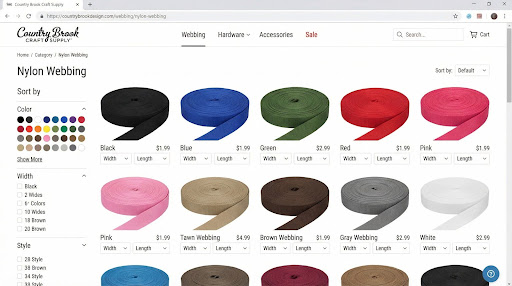
On the flagship listing for 1-inch heavy nylon, the numbers read like lab results: $3.75 per yard, 1.75 mm thick, and 4,100 lb tensile strength. Those details let you match hardware and calculate safe working loads without guessing.
Country Brook also notes that “some rolls may contain factory splices” and encourages you to request a continuous cut—a small line that builds big trust.
The service backs up the specs. Orders for in-stock items placed before 1 pm CST ship the same day, and standard stock goods can be returned within 30 days for a no-hassle refund, according to the company’s FAQ page.
Need social proof? That same 1-inch webbing holds a 100 percent five-star score across 14 verified reviews, confirming that the specs match reality.
With more than two dozen colors, matching hardware a click away, and clear shipping clocks, Country Brook delivers spec clarity and predictable fulfillment.
Strapworks: Mil-Spec Muscle With Crowd-Backed Credibility
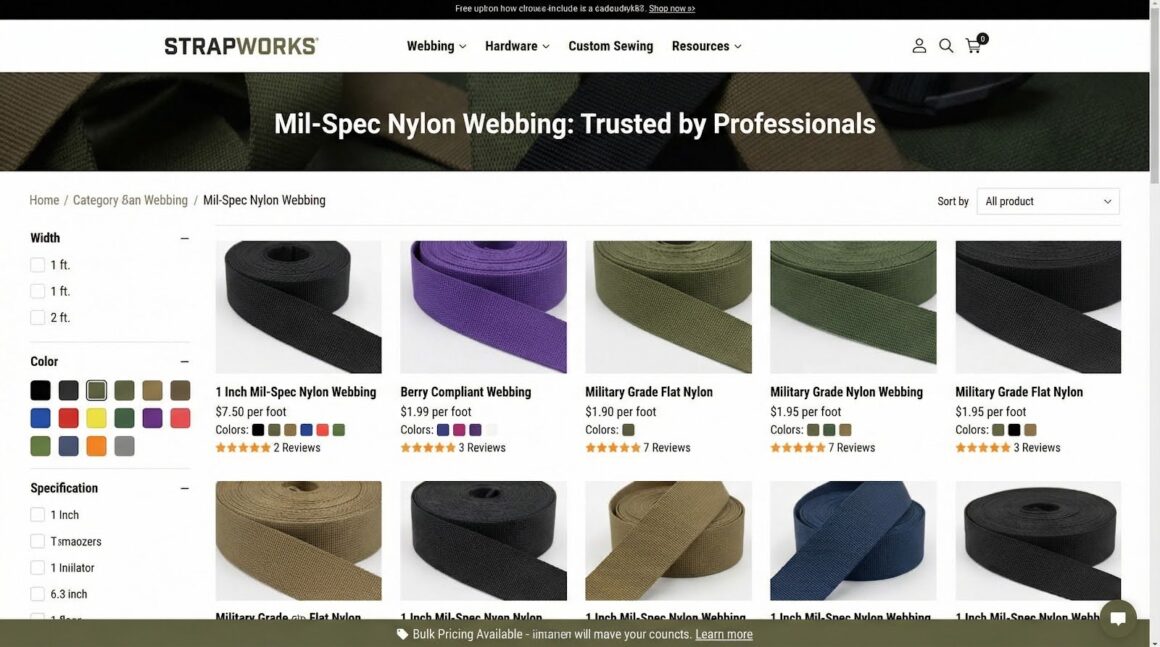
Strapworks is the spot when MIL-W-17337 nylon is non-negotiable. On the 1-inch Mil-Spec page the price shows $0.84 per foot (about $2.52 per yard) with roll discounts that drop to $0.59 per foot on a 300-foot spool. A Berry-compliant filter and camo-print options turn a spec hunt into a two-click sort.
According to Trustpilot, the company holds a 4.7-star rating built on more than 9,900 reviews—strong social evidence.
Service details reinforce the numbers. Website orders over $100 ship free inside the contiguous US, and the cart flags custom cuts that void returns. Strapworks also notes that runs longer than 30 feet may contain splices and invites you to request continuous lengths if needed.
Combine those policies with same-week lead times, and you get a supplier that lets you test your design on a tight schedule without testing their reputation.
WAWAK: Stretch Your Budget, Not Your Webbing
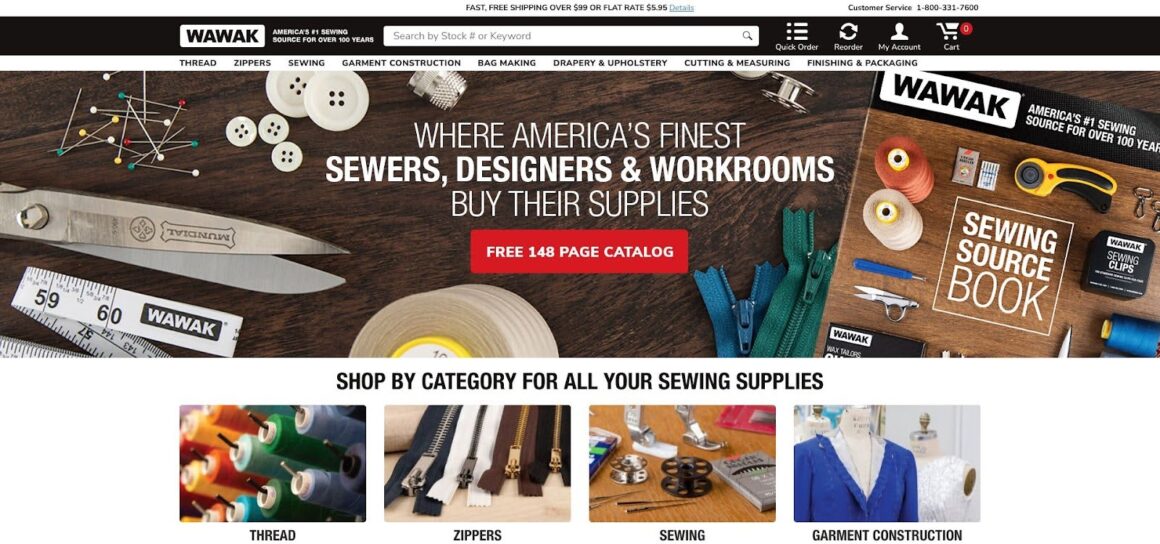
WAWAK is the sewing-notions go-to when you need only a few yards and prefer quick shipping over exotic specs. The Heavy-Weight Nylon Webbing page lists bundle prices from $9.85 for 5 yards to $64.95 for 50 yards (about $1.97 to $1.30 per yard).
Strength is modest. The downloadable spec chart puts the 1-inch heavy webbing at around 600 lb break strength, enough for bag handles and pet collars but not for load-bearing harnesses. Need more muscle? The seat-belt nylon version reaches 6,000 lb at a slightly higher price.
Reputation is limited. Trustpilot shows a 3.3 score from just nine reviews, so quality data are slim. Order an extra yard, inspect the weave, and trim if it meets your standard.
Shipping drives the delivered price. Orders below $99 pay a flat $5.95, while higher totals ship free. Most parcels leave the warehouse the same day if you order before 4 pm ET and arrive in two days via FedEx to continental US addresses. Bundling thread, zippers, or needles helps you clear the free-freight line.
Bottom line: WAWAK delivers wallet-friendly nylon for light-duty straps and craft shows, as long as you double-check the specs before cutting.
Seattle Fabrics: Outdoor-Ready Webbing For Gear That Earns Mileage
When trail grit, salt spray, or desert sun are on the itinerary, Seattle Fabrics tops the list. The 1-inch heavy nylon webbing costs $1.50 per yard and carries a published break strength of about 3,800 lb—enough for pack straps, dog gear, or hammock suspensions. Need something lighter? The standard nylon sits near $1.35 per yard with a still-respectable ~1,000 lb rating.
Because the site stocks X-Pac, spacer mesh, and bar-tack thread, you can build an entire pack kit in one cart. A $4 processing fee covers order handling, and checkout shows a live UPS/USPS quote so you can trade speed for cost. Rush or UPS 2-day orders placed before 2 pm PT usually ship the same day, handy when you are racing a trip deadline.
Product blurbs note UV fade resistance and abrasion tests, helping you decide whether black stays black after a season in the sun or a daisy chain will fuzz on granite.
Bottom line: Seattle Fabrics supplies expedition-ready nylon without full mil-spec pricing, and the real-time freight calculator keeps surprises out of your budget.
Rockywoods: Transparent Shipping For The Gram Counters
Rockywoods caters to makers who track every ounce and every penny. A click on the 1-inch standard nylon webbing page shows $1.03 per yard and a 1,000 lb break strength, while the heavier mil-spec 55301 option rises to $1.55 per yard. Tubular versions cost more but keep Berry compliance intact.
Before you enter a card, the cart displays real-time carrier rates with no mark-ups. Rockywoods’ “Shipping Promise” explains how a few extra ounces can flip a five-yard envelope to Priority Mail. Processing time sits at three business days, and next-day or second-day air orders ship the same or next business day.
Returns on cut yardage are off the table, but defects earn a replacement or refund, so you know where you stand before clicking “buy.”
With tight color consistency, reliable stock, and the option to bundle coated fabrics from the same Fort Collins warehouse, Rockywoods offers precise inputs, predictable outputs, and zero shipping guesswork.
Ripstop by the Roll: Ultralight Mindset, Community-Grade Support
If you count grams like other thru-hikers, Ripstop by the Roll keeps your spreadsheet honest. The current 1-inch nylon webbing sells in 10-foot sections for $5.50 (about $4.95 per yard) and weighs ~4.5 g/ft (14.8 g/m).
Specs sit in a tidy chart: width options, Berry-compliant note, and weight per foot. Need more muscle? The polyester variant lists a 1,500 lb break strength and ships in 25-foot cuts for $9 per section.
Checkout still favors ounce-shavers. Orders usually leave Durham, North Carolina within two business days, and parcels under 8 oz qualify for First-Class Mail, keeping shipping under five dollars.
If you need a continuous run, add a note at checkout and the team will cut up to 100 ft without splices.
The real draw is the maker community. Each SKU links to build photos in the Project Gallery, and staffers answer sewing questions in forums after hours. That blend of hard data and peer examples turns RBTR from supplier into design partner, helpful when you are bar-tacking webbing at midnight and want proof that someone else pulled it off first.
Sailrite: Built For Boats, But Handy Anywhere Water Wins
Salt water can fade dye and lock nylon fibers stiff. Sailrite’s solution-dyed marine webbing counters both: pigment is infused in the yarn and a resin dip limits water uptake.
Expect to pay more for that protection. A 1-inch lightweight nylon webbing lists at $5.80 for a 10-foot piece (≈ $5.22 per yard), while the heavy-duty version rises to $16 for a 10-foot cut. The spec chart sets the 1-inch lightweight at 1,415 lb break strength and records only slight strength loss after soaking.
Pages also warn that long orders may include a factory splice, so request a continuous run if you need one.
Perks go beyond specs. Sailrite’s YouTube channel walks through bar-tacking D-rings without a walking-foot machine and adding chafe guards, useful when you are sewing on deck.
Shipping is predictable: FedEx Ground is free on U.S. orders of $199 or more; smaller carts pay actual carrier postage at checkout. International service is available, but duties stay on you.
Bottom line: If your strap will live on deck or anywhere corrosion rules, Sailrite’s marine-grade nylon delivers reliable performance along with step-by-step video help.
Buckleguy: When Webbing And Hardware Need To Match Like Twins
Buckleguy is the fashion-hardware specialist that lets your nylon and metal accents line up perfectly. The 1-inch nylon webbing comes in two-yard packs for $5.50 (about $2.75 per yard) or a 10-yard roll for $22 ($2.20/yd) in shades such as olive drab, slate, and chestnut. Break strength sits near 1,200 lb—enough for messenger straps and camera slings without venturing into climbing territory.
Quality touches earn repeat buyers. Edges arrive heat-sealed, dye lots stay consistent, and each listing notes the buckle size and tongue clearance to pair with Buckleguy sliders and snaps.
Service is predictable: flat-rate $7.99 shipping under $100, free above that line, plus 30-day returns on uncut webbing. Trustpilot shows a 4.2 score across 36 reviews—solid for a niche craft supplier.
If matching metal hardware to nylon webbing feels like a chore, Buckleguy turns it into a color-corrected, low-stress checkout.
REI: Grab-And-Go Straps For Midnight Packing
It is 10 pm, the road trip starts at dawn, and your tie-downs are still a pile of loose webbing. That is when you open REI.com or drive to the nearest co-op. Instead of raw yardage, REI stocks sewn systems like the Nite Ize CamJam Ratchet Strap. For more on choosing the right pack that pairs perfectly with reliable straps, check out these travel-ready backpacks that suit every adventure : a 12 ft, 1-in kit rated to 500 lb working load and 1,500 lb break strength for $35 per single strap or $65–$75 for a two-pack.
Need something lighter and cheaper? Gear Aid 1-in utility straps come as a two-pack for about $12 and cover camp-box or bike-rack duty.
Returns follow classic REI rules: a one-year 100 percent satisfaction guarantee lets you bring unused straps back for a full refund. Members get free standard shipping on most orders, while non-members pay carrier-rate at checkout.
Color and length options stay basic—black or bright neon in fixed sizes—so if you want custom hues or tubular webbing, revisit the specialty shops above. For last-minute projects where “done” beats “DIY,” REI’s off-the-shelf straps deliver review-backed reliability without an evening at the sewing machine.
Amazon: Speed Meets The Spec Minefield
Amazon lists more nylon webbing than most specialty sites combined, but you trade curation for chaos. A quick search shows 20 yards of 1-inch black “heavy-duty” nylon for about $18 to $22 with Prime two-day shipping, yet many listings omit basics like tensile strength or even fiber type; some products are polypropylene dressed up as nylon.
Here is the safety checklist to follow before you click Buy Now:
- Verify the numbers. Look for a manufacturer image that shows break strength or thickness in millimeters. No numbers, no cart.
- Confirm the unit. Scroll the Q&A and “Item Length” line; some sellers quote price per foot, others per full roll.
- Inspect weave photos. Filter reviews by “images” and zoom in. Fuzzy edges or uneven ribs often signal recycled blends.
- Check Prime plus returns. Make sure the listing is “Ships from and sold by Amazon” or a top-rated seller so the standard 30-day free return really applies.
If a SKU clears those four hurdles, Amazon remains the fastest way to restock a workshop on short notice. Skip one and you risk webbing that arrives half-weight or spliced every few feet. Instant gratification is possible only when you buy like a quality inspector, not a casual shopper.
Etsy And eBay: Niche Colors, But Vet The Seller Like A Supplier
When you need tie-dye webbing for a festival sling or any pattern the big stores do not carry, Etsy and eBay can help. Small shops hand-dye, print, or laser-etch nylon in micro batches, so the color palette feels endless. The trade-off is that quality control sits with the seller, not the platform.
Here is the screening routine we follow:
- Inspect the weave. Zoom product photos until you can count ribs; crisp edges often signal fresh nylon, while fuzz hints at recycled yarn.
- Check seller stats. Look for 4.8 stars or higher and at least 100 sales on Etsy, or 99 percent positive feedback on eBay. Lower numbers raise risk.
- Confirm ship-from location and timing. A five-yard cut from overseas can take three weeks, a problem if you need it by next Friday.
- Read return terms. Few shops accept cut yardage, but if they do—and platform protections cover it—that is a good sign.
- Scan reviews for dye bleed or shrinkage. Two recent complaints are enough to move on.
Follow those steps and these marketplaces become color playgrounds where cost per yard takes a back seat to getting the exact hue your project demands. Skip them and you may face off-spec widths, late arrivals, and mystery fiber.
How To Choose Nylon Webbing Online
Nylon vs. Polypropylene vs. Polyester: Start With The Fiber
Nylon
- Pros: soft hand, absorbs shock, bar-tacks cleanly.
- Cons: picks up moisture (up to five percent by weight) and stretches about 5–7 percent at rated load; great for dynamic falls, less ideal for static slings.
Polypropylene
- Pros: almost no water absorption, floats, resists mild acids.
- Cons: weakest UV performer; expect noticeable embrittlement after a full summer on a roof rack without a UV stabilizer.
Polyester
- Pros: reaches nylon-class tensile strength with roughly 2 percent stretch, resists sunlight, and stands up to most chemicals.
- Cons: slightly heavier yarn denier for the same break strength.
Quick picker:
- Worried about shock loads → choose nylon.
- Need waterproof plus float → choose polypropylene.
- Care about UV resistance and low stretch → choose polyester.
Price-Comparison Method: Make Every Yard Count
Sticker price is only the first line of the receipt. To compare apples to apples, use one reference SKU: 1-inch black nylon, quoted per yard, shipped to ZIP 94016 (San Francisco, CA). Then walk through three filters:
- Normalize the unit.
- Price listed per foot? × 3.
- Sold only as a 25-yard roll? ÷ 25.
- Minimum purchase 10-ft pack? ÷ 3.33.
Drop each result into a “normalized $/yd” column and add a “continuous-length” flag so hidden splices do not skew the math.
- Add shipping.
- Country Brook’s $3.75/yd ships in an $8.50 flat-rate box, landing at $4.45/yd for a 5-yard cut.
- Strapworks crosses its $100 free-shipping line at 48 yd, turning a $2.52/yd foot-rate into $2.52 delivered when you buy the whole roll.
No freight, no comparison.
- Tag the extras.
- Sales tax (9.125 percent in San Francisco)
- Cut fees (Rockywoods + $2 on sub-yard increments)
- Splice-free surcharges (Country Brook + $3)
A quick margin note keeps these from surprising your budget.
Follow the three filters and the cheapest headline number can no longer mislead you. Real bargains pop; fake ones fade before you place the order.
Shipping & Returns: The Hidden Cost Center
Webbing is dense. A five-yard envelope ships First-Class for about $5, while a 50-yard roll climbs to $14–$18 via Priority Mail or UPS Ground, often doubling the delivered price. Because many stores hide rates until the last screen, we judge shipping and returns as strictly as tensile strength.
- Real-time calculators (Rockywoods) show a running UPS/USPS quote as you add yards, so you can adjust weight classes on the fly.
- Flat tiers (Country Brook: $8.50 box under $100, free above) are transparent, and you can hit the threshold by adding buckles.
- Hybrid models (Strapworks) add a small handling fee yet waive freight past $100, making bulk rolls cheaper per yard than piecemeal cuts.
Returns on cut webbing are rare. Most shops treat custom length as final sale. If a retailer accepts returns on uncut yardage (Buckleguy, 30 days) we flag that as a service bonus; it suggests clean stock and accurate cutting.
Before you place the order, watch for three red flags:
- Restocking fees—even on defective goods (WAWAK charges 20 percent).
- “Estimated” shipping that changes after checkout.
- Mandatory signature on low-value parcels that can add $4–$6.
Spot any of these and consider another supplier; strong webbing feels weak when hidden fees hit your statement.
Customer Sentiment: Read The Feedbacks Before You Swipe
Specs tell you what a strap can handle; reviews show how a seller treats you. Star counts alone mislead, so look at both rating and sample size:
- Strapworks: 4.7 on more than 9,900 Trustpilot reviews, enough data to mute an occasional shipping hiccup.
- WAWAK: 3.3 on only nine reviews, too thin to judge fairly.
As a rule of thumb, treat 500 reviews or more as high volume and anything under 50 as anecdotal.
Dig deeper than decimals:
- Filter recent comments for patterns such as cut accuracy, color drift, or response time. One rant is noise; ten in a month signals trouble.
- Scan seller replies. A polite, time-stamped fix builds confidence that your issue will receive the same attention.
- Check photo reviews. Close-up shots of weave edges can save a return. When customer photos match the store’s images, trust rises; when they do not, move on.
Bottom line: volume, consistency, and proactive replies turn a supplier from a tentative pick into one you will gladly reorder from.
What’s Changing Right Now: PFAS Bans And Recycled Nylon
In February 2025 France adopted one of the world’s toughest PFAS laws, banning “forever-chemical” uses in most consumer textiles by January 2030. At least five U.S. states, including California and New York, are drafting similar bills for outdoor gear. Why should a DIY sewist care? Many water-repellent finishes and neon dyes rely on PFAS chemistry, so factories are reformulating coatings right now. Expect some colors to disappear or look slightly different over the next year.
The bright spot is recycled nylon, with suppliers offering recycled nylon webbing like Country Brook Crafts labeling certain SKUs as “100 percent recycled.Country Brook already labels certain SKUs as “100 percent recycled.” Analysts at Deep Market Insights say Europe held 38 percent of the recycled nylon yarn market in 2024, and global demand is climbing nearly eight percent a year. Tensile specs match virgin fiber, but melt points and dye uptake can shift a few degrees.
Action steps
- Order a one-yard test cut before buying the big roll to check hand feel and bar-tack settings.
- Ask for a PFAS-free or GRS certificate in the order notes if the claim matters to your brand.
FAQ: Fast Answers To Common Webbing Questions
Is nylon webbing waterproof?
Not quite. Nylon can absorb 8–10 percent of its own weight in water and lose 10–15 percent of tensile strength when wet before recovering as it dries. For lashings that must stay dry, pick polyester or polypropylene, or use a PU-coated nylon tape.
Does nylon handle UV exposure well?
Better than polypropylene, but not as well as polyester. Lab tests show untreated nylon retains only 60–65 percent of its strength after 1,000 hours of UV, while polyester keeps 85–90 percent. Black or solution-dyed colors slow fading, yet plan to replace nylon straps that live in full sun every couple of seasons.
What width should I choose for a backpack strap?
Most commercial packs use 25–38 mm (1–1.5 in) webbing for shoulder straps and 20 mm (¾ in) for sternum straps. Wider strips spread the load and feel softer, while narrower ones cut weight. Match your hardware slots first, then fine-tune comfort.
Why do some sellers warn about splices?
Mills fuse short runs during production to reduce waste, creating a thicker splice every 25–30 yd. That bump can jam a triglide or weaken a safety-critical run. If you need an uninterrupted length (for example, a hammock suspension), add “continuous roll, please” in the order notes.
Can I use flat nylon webbing for climbing?
No. UIAA- and CE-certified tubular webbing or sewn slings pass dynamic-fall tests; flat nylon lacks the stretch and redundancy those standards require. If a line will hold a person, buy gear that is explicitly rated for climbing.
Conclusion
Choosing the right nylon webbing source comes down to matching specs, shipping speed, and budget to your project’s demands. Use the comparison methods above, read current reviews, and factor in hidden costs before you click “buy.” Follow those steps and you’ll secure straps that hold up in the real world—without overpaying or waiting weeks for delivery.
More Stories
How to Make Awkward Spaces Work Harder in Your Home
Why Two Identical Fences Age Completely Differently
Buying Beachfront Property in Thailand: What Foreign Buyers Should Check First